About Jayce

A young mind in the top 0.06% — and what that really means

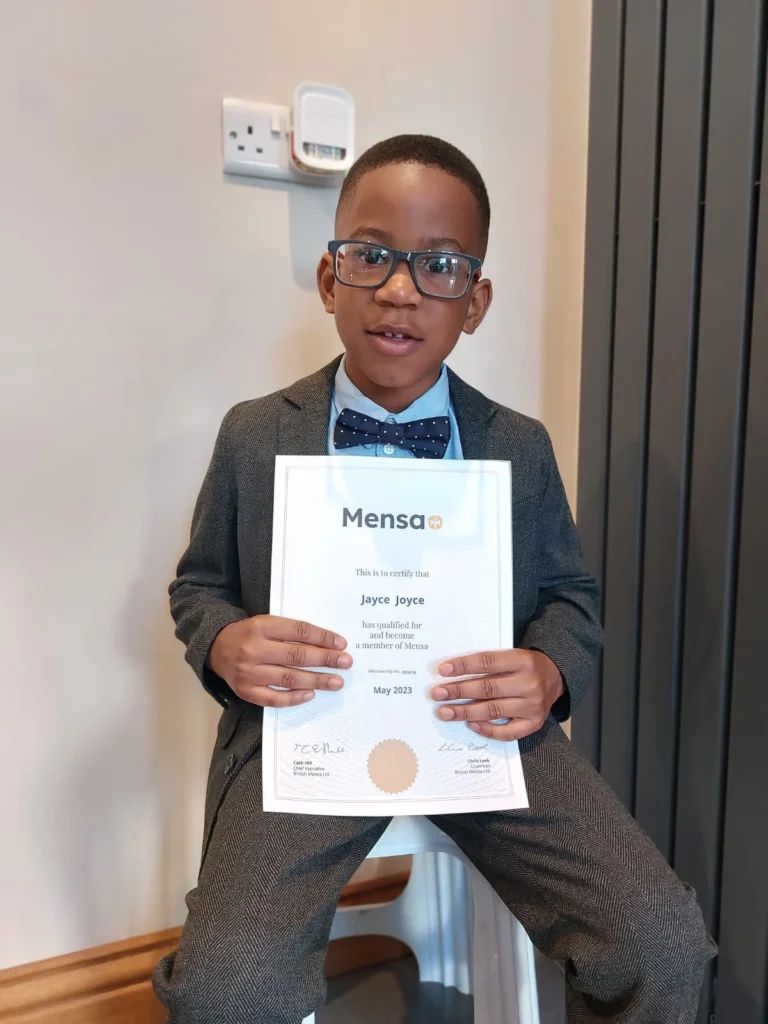
At seven years old, Jayce Joyce BCyA holds an IQ of 150 and is one of the youngest members of British Mensa. But the number is not the headline — what he chooses to do with it is.

Jayce Joyce BCyA — Mensa member

The Membership

Mensa, in plain English

Mensa is the world's largest and oldest high-IQ society. Membership is offered to people who score in the top 2% of the population on a supervised, standardised intelligence test. Jayce was admitted to British Mensa as a child member after a clinical assessment confirmed an IQ of 150.

A score of 150 is approximately the 99.96th percentile — meaning fewer than four in every ten thousand people score that high. For a child, the assessment also factors in age-normed reasoning, working memory, processing speed, and verbal comprehension.

We share this not as a boast, but as context. It explains the pace at which Jayce reads, the depth at which he processes ideas, and why a structured creative outlet — books — became essential rather than optional.

150measured IQ
99.96thpercentile
2,000+books read
Age 4first published

What Giftedness Actually Looks Like

Beyond the test score

Giftedness is not a trophy — it is a profile. It comes with strengths that look effortless, and challenges that are easy to miss. Here is what it looks like, day to day, in Jayce's world.

📚

Voracious reading

Reads chapter books in a single sitting and remembers detail months later. Has read more than 2,000 books to date.

💭

Abstract thinking

Asks the kind of questions ("What if a country had no books?") that drive his stories — and his school assemblies.

Rapid pattern recognition

Spots structure in stories, music, and numbers quickly — which is why writing a coherent book series at age four was possible at all.

🧠

Strong working memory

Can hold characters, plot threads, and feedback notes in mind across long writing sessions.

🎯

Intense focus on interests

When a topic catches him — early literacy, dinosaurs, Black history — he goes deep, fast, and won't let go.

❤️

Heightened sensitivity

Feels social fairness and other people's emotions strongly. It is the engine behind his diversity advocacy.

From Score to Story

Why we put the books first, not the IQ

A high IQ on its own changes nothing. What changes things is what a child decides to do with the way their mind works. For Jayce, that has meant publishing four books before the age of seven, founding an independent press, and curating the UK's first nationwide child-led anthology.

We talk about Mensa because it gives parents, teachers, and journalists a useful shorthand. But on every school visit, every library workshop, and every page of every book, the message is the same: the work is the point. The score is just the starting line.

For Parents of Gifted Children

Five things we wish someone had told us sooner

  1. Asynchrony is normal. A gifted child can reason like an adult and feel like the eight-year-old they are — in the same minute.
  2. Intensity is not bad behaviour. Strong reactions are part of the wiring, not a failure of discipline.
  3. Boredom is the warning light. Stretch the work before you try to manage the mood.
  4. Find one true peer. One other child who "gets it" matters more than a roomful of polite acquaintances.
  5. Protect the play. Output is a by-product of curiosity. Crush the play and you crush the output.

In His Own Words

“Being in Mensa is cool, but writing books is cooler. Books are how I tell other kids that their stories matter too — even if no one has asked them yet.”
— Jayce Joyce BCyA, age 7

Frequently Asked

Questions parents ask us

Keep Exploring

More about Jayce

Stay Connected

Stay in Jayce's World

Get news about new books, school events, the writing competition, and Jayce's latest adventures.